
Humanitarian & Compassionate (H&C)
When the rules don’t fit your situation but your circumstances are compelling, H&C can open a door to permanent residence.
Legally reviewed by Inna Kogan, BA, LL.B., MBA — licensed immigration lawyer, Law Society of Ontario · Last updated

Humanitarian & Compassionate applications ask Canada to grant status based on real hardship — your establishment here, the best interests of children, and ties to the community. They are discretionary and evidence-heavy; the story has to be told properly.
How Inna helps
- Honestly assess whether H&C is your strongest route
- Build the establishment and hardship case
- Frame the best interests of any children involved
- Assemble persuasive evidence and support letters
- Draft detailed legal submissions and represent you
Humanitarian & Compassionate (H&C)
People without status who are well established in Canada
Families where children’s best interests are at stake
Those who face real hardship if forced to leave
What a humanitarian and compassionate application is
Section 25(1) of the Immigration and Refugee Protection Act allows the Minister to grant permanent residence, or an exemption from a requirement of the Act, when humanitarian and compassionate (H&C) considerations justify it, taking into account the best interests of any child directly affected. It is the safety valve of Canadian immigration law: a route for people whose circumstances are compelling but who do not fit, or no longer fit, a standard program.
It is also discretionary and very slow. IRCC told a parliamentary committee in March 2026 that 68,400 people were in the in-Canada H&C inventory at the end of January 2026, and that most new applicants in the H&C and other category can expect to wait more than ten years for a decision. The 2026–2028 Immigration Levels Plan sets a 2026 target of 1,100 H&C admissions. An H&C application is therefore rarely a quick fix. It is a serious, long-term request that should be built properly from the start and weighed against any other route that may be open to you.
How officers assess an H&C request
Since the Supreme Court of Canada’s decision in Kanthasamy v. Canada (Citizenship and Immigration), 2015 SCC 61, officers must weigh all of the relevant facts and factors together in a global assessment, rather than testing each one against a hardship threshold. The phrase “unusual and undeserved or disproportionate hardship” describes the kind of circumstances that may justify relief; it is not three separate hurdles. A directly affected child’s best interests must be well identified and examined with a great deal of attention. IRCC’s guidance lists the factors officers commonly consider, including:
- Establishment in Canada: work history, community involvement, language skills, housing and finances
- Family ties in Canada and the consequences of separating relatives
- The best interests of any child directly affected, whether in Canada or abroad
- Hardship on return, including adverse country conditions and discrimination
- Health considerations, including whether needed treatment is available in the home country
- Family violence, and any other unique or exceptional circumstances
Who can apply, and who is barred for now
An in-Canada H&C application is made by a foreign national in Canada who is inadmissible or does not meet a requirement of the Act. Some situations prevent an application for a period of time:
- You already have an H&C request in process
- You have a refugee claim that has been found eligible for referral to the Refugee Protection Division, or that is pending at the Refugee Protection Division or the Refugee Appeal Division (this wording comes from a Bill C-12 amendment that took effect on November 3, 2026)
- Less than 12 months have passed since a negative refugee decision, or since the Federal Court refused leave or dismissed judicial review of one, unless removal would put a life at risk because of inadequate medical care or would harm the best interests of a directly affected child
- You are a designated foreign national, in which case a five-year waiting period applies
H&C cannot overcome inadmissibility on security, human or international rights violations, sanctions or organized criminality grounds. And in an in-Canada application, risk of persecution or harm under the refugee provisions is not weighed as such; the officer assesses hardship instead, so the application must be framed around hardship evidence.
Fees, forms and the two-stage process
Applications are now made online through IRCC’s Permanent Residence Portal; paper applications are available only as an accommodation. Since April 30, 2026 the fees are $1,260 for the principal applicant ($660 processing fee plus the $600 right of permanent residence fee), $1,260 for an included spouse or partner, and $180 for each dependent child.
Processing has two stages. At stage 1 an officer decides whether H&C considerations justify an exemption, known as approval in principle. At stage 2 IRCC confirms admissibility, including medical, criminality and security checks, before granting permanent residence.
Removal, work permits and status while you wait
Filing an H&C application does not delay removal from Canada. If a removal date is set while the application is pending, other steps may be needed, such as a request to defer removal or, in urgent cases, a motion for a stay at the Federal Court. After a positive stage 1 decision, the Immigration and Refugee Protection Regulations stay a removal order until the final decision on permanent residence.
Work authorization follows the same logic: an applicant can apply for a work permit once the stage 1 exemption is granted, but simply having applied is not enough. Anyone relying on an H&C application to stay in Canada should get advice on their current status and any removal risk at the outset.
Building a strong H&C application
Strong H&C files share a few features. They tell one coherent story, from the reason you came to Canada to the life you have built here. Every claim is supported by documents: tax returns, employment letters, school reports, letters from people in your community who know you well, medical records, and credible reports on conditions in your country of origin. Where children are involved, the submissions address their particular needs and what removal would mean for them, rather than relying on general statements.
The legal submissions then apply the Kanthasamy approach directly, asking the officer to weigh everything together. Inna Kogan personally develops the strategy for each file, and you will get an honest view, before you pay fees and wait years, of whether H&C is your strongest route or whether another program fits better.
If your H&C application is refused
A negative H&C decision can be challenged by an application for leave and judicial review at the Federal Court of Canada. For a matter arising in Canada the deadline is generally 15 days from the day you learn of the decision; for one arising outside Canada it is 60 days. The Court does not decide the case again, but it can set aside an unreasonable decision, for example one that ignored key evidence or assessed the factors one at a time instead of together, and send it back to a different officer. A new application is also possible, and given the processing times, the choice between the two deserves careful advice.
Official resources
Authoritative government sources referenced on this page:
- Justice Laws: Immigration and Refugee Protection Act, section 25
- Supreme Court of Canada: Kanthasamy v. Canada, 2015 SCC 61
- IRCC: Humanitarian and compassionate considerations (application package)
- IRCC: H&C assessment of hardship (officer instructions)
- IRCC: Fee list
- IRCC: Briefing to the Standing Committee (CIMM), March 23, 2026: H&C and other immigration
This page is general information, not legal advice. For advice on your situation, book a consultation with Inna Kogan.
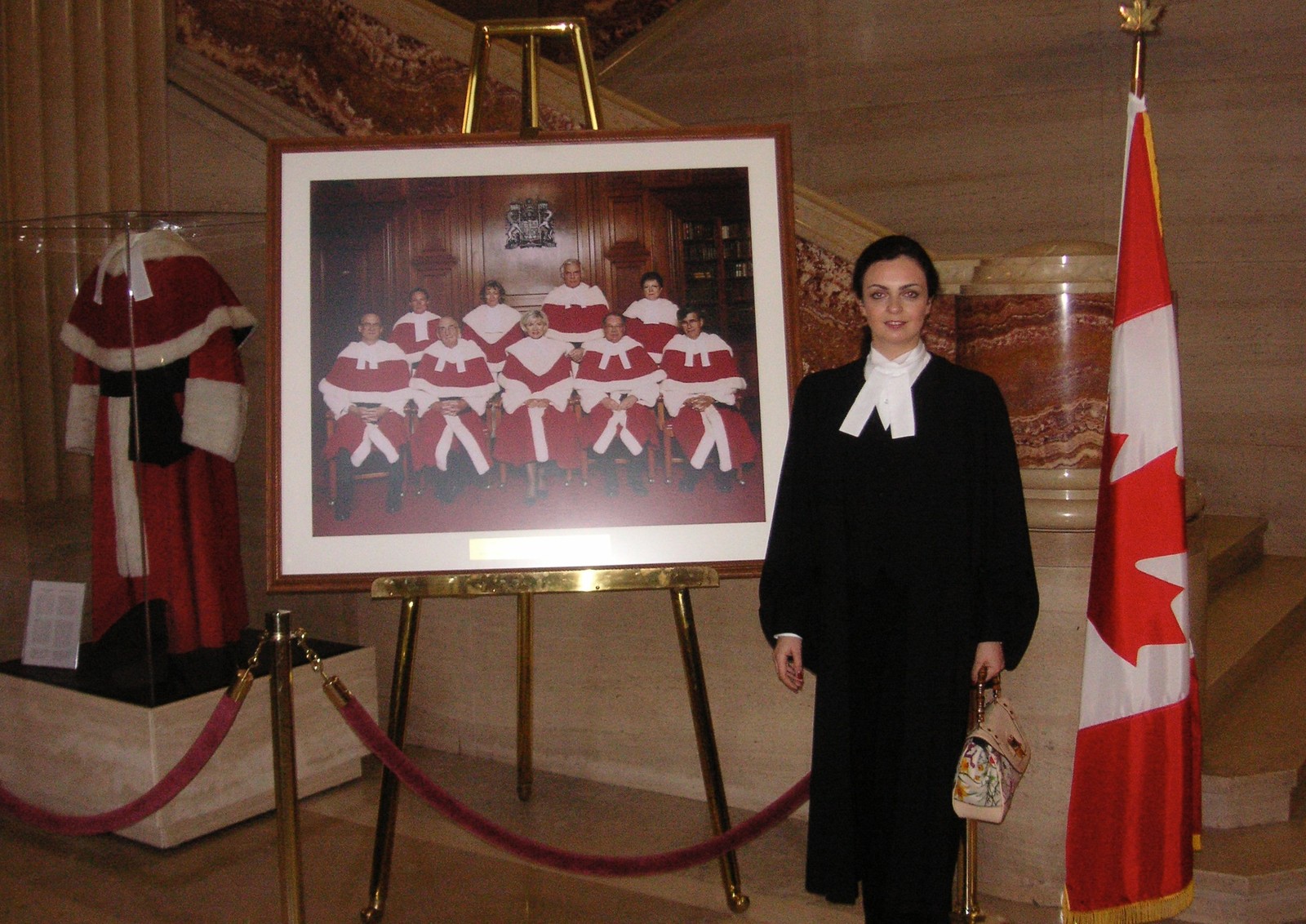
We go to court
A refusal is not always the end. Inna Kogan challenges unreasonable visa refusals and long delays at the Federal Court of Canada.
Appeal a refusalThree simple steps to your consultation
Request a consultation
Fill out the form on this page and leave your contact details.
Receive your questionnaire
I email you a short questionnaire — please check your spam folder too.
Confirm your Zoom
You receive an invitation to meet Inna online. Confirm it, and we begin.



Humanitarian & Compassionate (H&C) — questions & answers
What is a humanitarian and compassionate (H&C) application?
It is a request under section 25(1) of the Immigration and Refugee Protection Act for permanent residence, or an exemption from a requirement of the Act, based on compelling personal circumstances: establishment in Canada, family ties, the best interests of a child directly affected, and the hardship you would face if you had to leave.
How long does an H&C application take in 2026?
A long time. IRCC told a parliamentary committee in March 2026 that most new applicants in the H&C and other category can expect to wait more than ten years for a decision, and the 2026 admissions target for H&C is 1,100 people. A file that is truly delayed beyond what is reasonable can sometimes be advanced with a Mandamus application, but the starting point is a long wait.
How much does an H&C application cost?
Since April 30, 2026: $1,260 for the principal applicant ($660 processing plus $600 right of permanent residence fee), $1,260 for a spouse or partner, and $180 for each dependent child. Biometrics fees may also apply.
Does an H&C application stop removal from Canada?
No. Filing does not delay removal. A positive stage 1 decision stays a removal order until the final permanent residence decision, but before that point other steps, such as a deferral request or a Federal Court stay motion, may be needed. If you face removal, get advice immediately.
Can I apply for H&C after my refugee claim was refused?
Usually not for 12 months after the negative decision, or after the Federal Court refused leave or dismissed judicial review. Exceptions apply where removal would risk a life because of inadequate medical care or would harm the best interests of a directly affected child.
Can I work while my H&C application is in process?
Not just because you applied. You can apply for a work permit once you receive a positive stage 1 decision (approval in principle). Until then, your ability to work depends on any other status or permit you hold.
Book a personal consultation with Inna
Leave your details and I will send you a questionnaire and a Zoom invitation.
Book a personal consultation with Inna
Leave your details and I will send you a questionnaire and a Zoom invitation.
Ready to move forward?
Book a personal consultation with Inna and get a clear, honest assessment of your case.
Book a Consultation